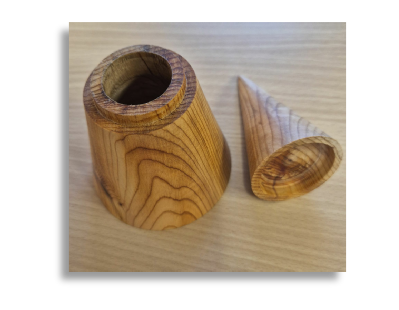
A lidded wooden form can be read as a complete object or as two related parts. The lid introduces a meeting line, and that line may be understated or deliberately visible. Its position influences how the eye divides the piece and how the upper and lower profiles relate.
Consider what happens when the lid is removed. Does it have a visual character of its own? Does the open container still look resolved? These questions help move the design beyond a single closed view. They are especially useful when an object will be handled and displayed in different arrangements.
A finial or raised top can become a focal point. Its scale should be considered alongside the width and height of the body. Drawing a plain lid, a low raised lid and a more prominent top gives three ways to explore the same container without changing its lower half.
The archive image is an illustration for studying relationships between parts. It does not supply measurements or a making sequence. Use it to discuss continuity, contrast and the meeting line, then record which choices you would keep or change in an independent design.