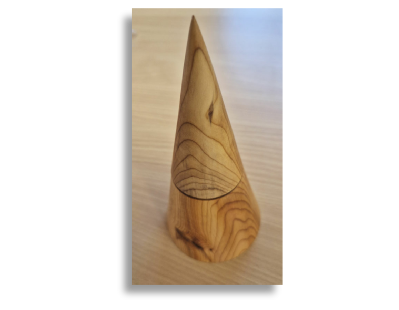
Tall wooden ornaments draw attention through their vertical rhythm. A sequence of wider and narrower sections can lead the eye upwards, while a restrained profile can let grain supply the detail. Their character depends on the relationship between height, width and the shape of the support.
A useful drawing exercise is to divide the overall height into a few broad sections. Identify where the form expands, where it contracts and where the eye pauses. Too many similar accents may make the outline feel crowded; a quieter passage can give a principal feature more room.
Negative space also matters in a display. A tall piece placed among several equally tall objects can lose its distinction, while a lower neighbour may make the vertical line easier to appreciate. Compare the silhouette alone with the silhouette in a small group.
The archive photograph provides an example of an upright decorative form. Study it as an arrangement of proportions rather than as an exact project plan. A few thumbnail sketches can capture different possibilities, allowing the design to develop on paper before questions of materials and construction are addressed.